Mastering PSLF: Your 2026 Guide to Public Service Loan Forgiveness
Are you a dedicated public servant burdened by student loan debt? The Public Service Loan Forgiveness (PSLF) program offers a beacon of hope, promising to erase your remaining federal student loan balance after 120 qualifying payments. As we approach 2026, understanding the nuances of this program is more critical than ever. This comprehensive PSLF 2026 Guide is designed specifically for public sector employees like you, providing a step-by-step roadmap to navigate the complexities and ultimately achieve financial freedom. Whether you’re just starting your journey or are nearing the finish line, this guide will equip you with the knowledge and strategies necessary to maximize your chances of success.
Anúncios
The PSLF program was established to encourage individuals to enter and remain in public service, acknowledging the vital contributions these professionals make to our communities. However, its requirements can be intricate, leading to confusion and, at times, disappointment for those who don’t fully understand the rules. This guide aims to demystify the process, offering clear, actionable advice to help you stay on track for loan forgiveness by 2026. We’ll cover everything from eligibility criteria and qualifying employment to the critical role of income-driven repayment plans and the essential steps for tracking your progress. Let’s embark on this journey together towards a debt-free future.
Understanding the Core of PSLF: What You Need to Know
At its heart, the Public Service Loan Forgiveness (PSLF) program is straightforward: work full-time for a qualifying employer, make 120 qualifying monthly payments, and the remaining balance on your Direct Loans will be forgiven. However, each of these components has specific definitions that are crucial to comprehend. Failing to meet even one requirement can jeopardize your eligibility. This section of our PSLF 2026 Guide will break down these foundational elements, ensuring you have a solid understanding from the outset.
Anúncios
Qualifying Employment: Who is Eligible?
One of the most common misconceptions about PSLF revolves around what constitutes ‘qualifying employment.’ It’s not just about the type of job you have, but more importantly, who your employer is. Generally, qualifying employers include:
- Government organizations at any level (federal, state, local, or tribal)
- Not-for-profit organizations that are tax-exempt under Section 501(c)(3) of the Internal Revenue Code
- Other not-for-profit organizations that provide certain public services
It’s important to note that working for a for-profit organization, even if it provides public services (e.g., a for-profit hospital or charter school), does not qualify. Additionally, services as a full-time AmeriCorps or Peace Corps volunteer also count. For the purposes of PSLF, ‘full-time’ generally means working at least 30 hours per week. If you work multiple part-time jobs, they can sometimes be combined to meet the full-time requirement if they are all with qualifying employers.
Eligible Loans: Direct Loans Only
Only federal Direct Loans are eligible for PSLF. This is a critical distinction. If you have Federal Family Education Loan (FFEL) Program loans or Federal Perkins Loans, they are not eligible for PSLF unless you consolidate them into a Direct Consolidation Loan. It’s crucial to do this before you make any qualifying payments, as payments made on non-Direct Loans do not count, even if you later consolidate them. This is a key area where many applicants have faced issues in the past, so ensure all your loans are Direct Loans or have been consolidated into one.
Qualifying Payments: The 120-Payment Rule
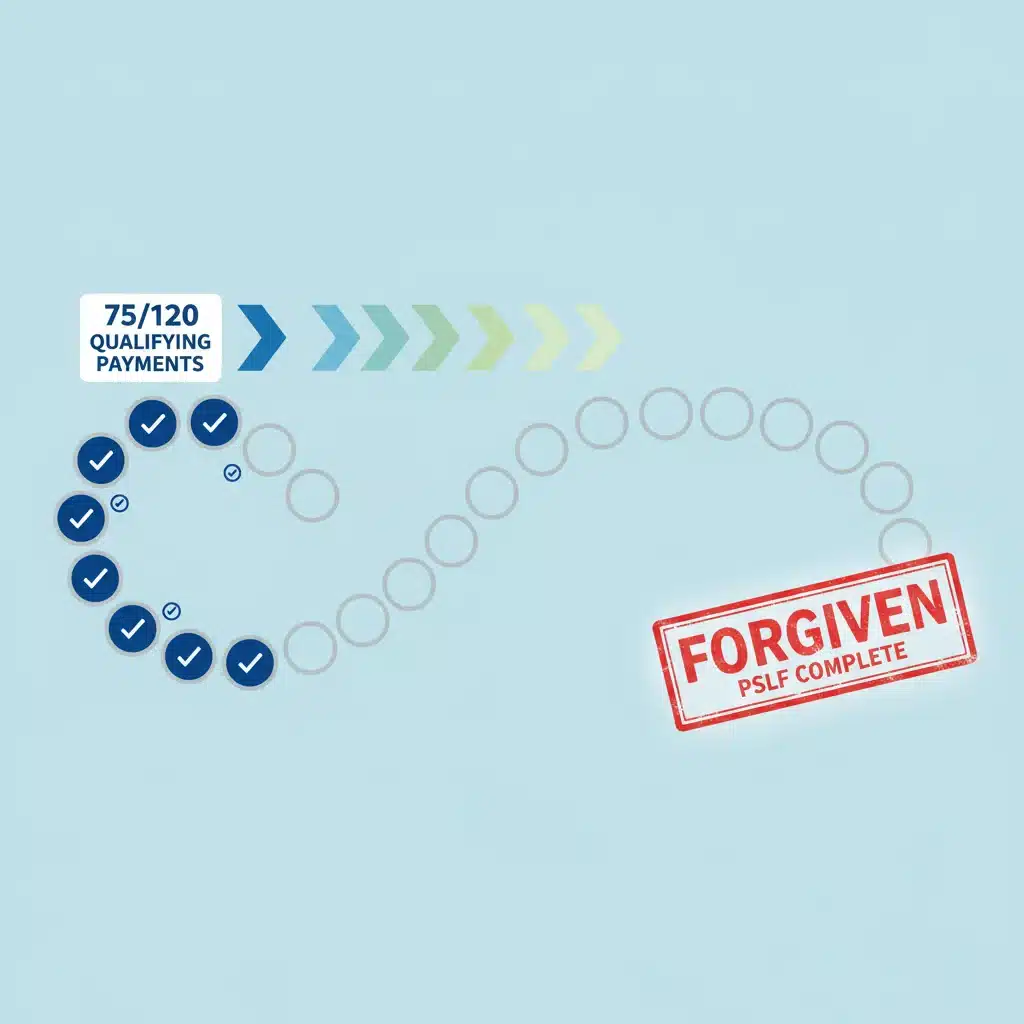
To receive PSLF, you must make 120 qualifying monthly payments. These payments must meet several criteria:
- Made after October 1, 2007: Payments made before this date do not count.
- Made under a qualifying repayment plan: This almost exclusively means an Income-Driven Repayment (IDR) plan. We’ll delve into IDR plans shortly.
- For the full amount due: Partial payments do not count.
- No later than 15 days after your due date: Timeliness is key.
- While you are employed full-time by a qualifying employer: Your employment status must align with your payment period.
It’s important to understand that the 120 payments do not need to be consecutive. If you change jobs, take a break from public service, or enter a period of deferment or forbearance, your payment count will simply pause until you resume qualifying employment and payments. However, periods of deferment or forbearance generally do not count towards the 120 payments, with some limited exceptions.
Navigating Income-Driven Repayment (IDR) Plans
For most borrowers pursuing PSLF, enrolling in an Income-Driven Repayment (IDR) plan is not just recommended, it’s essential. IDR plans calculate your monthly payment based on your income and family size, often resulting in a lower payment than standard repayment plans. This is particularly beneficial for PSLF, as it maximizes the amount of debt that can be forgiven, since you’re making lower payments over time.
Types of IDR Plans
There are several IDR plans available, and choosing the right one for your situation is crucial. The most common IDR plans include:
- Revised Pay As You Earn (REPAYE) Plan: Generally caps payments at 10% of your discretionary income.
- Pay As You Earn (PAYE) Plan: Also caps payments at 10% of discretionary income, but with additional eligibility requirements.
- Income-Based Repayment (IBR) Plan: Payments are 10% or 15% of your discretionary income, depending on when you took out your loans.
- Income-Contingent Repayment (ICR) Plan: Payments are either 20% of your discretionary income or what you’d pay on a fixed 12-year payment plan, whichever is less.
The Standard Repayment Plan is also a qualifying plan, but under this plan, your loans would be paid off in 10 years, leaving no balance to be forgiven. Therefore, IDR plans are almost always the strategic choice for PSLF. You must recertify your income and family size annually to remain on an IDR plan, and failing to do so can result in higher payments and a temporary halt to your qualifying payment count.

The PSLF Application Process: A Step-by-Step Guide
Applying for PSLF isn’t a single event; it’s a multi-year process that culminates in the submission of a final application. However, there’s a vital interim step that many borrowers overlook: the PSLF Employment Certification Form (ECF). This form is your best friend in tracking your progress and ensuring your employment and payments are on the right path. This section of our PSLF 2026 Guide will walk you through the entire application journey.
Step 1: Consolidate Your Loans (If Necessary)
As mentioned, only Direct Loans are eligible. If you have FFEL or Perkins Loans, you must consolidate them into a Direct Consolidation Loan. Do this as early as possible. Remember, payments made on non-Direct Loans before consolidation will not count towards PSLF.
Step 2: Enroll in an Income-Driven Repayment (IDR) Plan
Select the IDR plan that best suits your financial situation. You can use the Loan Simulator tool on StudentAid.gov to compare plans and estimate your payments. Ensure you recertify your income and family size every year to keep your payments accurate and your qualifying payment count on track.
Step 3: Submit the PSLF Employment Certification Form (ECF) Annually
This is arguably the most crucial step for tracking your progress. The ECF allows you to:
- Confirm your employer is qualifying.
- Verify your employment dates and full-time status.
- Receive an official count of your qualifying payments from MOHELA (the PSLF servicer).
It’s strongly recommended to submit this form annually, or whenever you change employers. Waiting until you’ve made all 120 payments to submit your first ECF is a risky strategy, as it could reveal issues that are difficult to correct retroactively. Regular submissions help you catch and fix problems early, making your path to PSLF by 2026 much smoother.
Step 4: Track Your Payments and Employment
While MOHELA tracks your payments, it’s wise to keep your own detailed records. Maintain copies of your ECFs, payment confirmations, and employment records. If there’s ever a discrepancy, your personal records can be invaluable in proving your case. Periodically review your payment count on MOHELA’s website to ensure it aligns with your expectations.
Step 5: Apply for Forgiveness After 120 Payments
Once you’ve made 120 qualifying payments, you will submit the actual PSLF Application for Forgiveness. This form confirms that you have met all requirements and officially requests the forgiveness of your remaining loan balance. You must be employed by a qualifying employer at the time you apply for forgiveness and at the time the remaining balance is forgiven. The application is typically available through StudentAid.gov.
Crucial Updates and Considerations for 2026
The PSLF program has seen significant changes and improvements in recent years, particularly with the Limited PSLF Waiver and the IDR Account Adjustment. While these initiatives have helped many borrowers, it’s essential to understand their implications and how they might affect your path to PSLF by 2026. Staying informed about program updates is a key aspect of this PSLF 2026 Guide.
The IDR Account Adjustment and Its Impact
The IDR Account Adjustment (sometimes referred to as the ‘IDR Waiver’) is a one-time initiative to address past inaccuracies in payment counting for both PSLF and IDR forgiveness. This adjustment offers a significant benefit by counting certain periods of deferment, forbearance, and even some periods of non-IDR repayment towards PSLF, which previously would not have qualified. The Department of Education expects to complete this adjustment for most borrowers by July 1, 2024. For those pursuing PSLF, this could mean a substantial increase in their qualifying payment count. It’s vital to ensure all your eligible loans are consolidated into Direct Loans before the adjustment is fully implemented to maximize its benefits. If you have older FFEL or Perkins loans, consolidating them now could make a dramatic difference in your PSLF timeline.
Future of PSLF: What to Expect by 2026
While the core structure of PSLF is expected to remain consistent, policy changes and regulatory updates can always occur. Staying abreast of official announcements from the Department of Education and Federal Student Aid is crucial. Our PSLF 2026 Guide emphasizes the importance of regularly checking StudentAid.gov for the latest information. As 2026 approaches, there might be renewed discussions about simplifying the application process or further expanding eligibility, though nothing is guaranteed. Proactive engagement with your loan servicer and consistent tracking of your progress remain your best defenses against unforeseen changes.
Common Pitfalls and How to Avoid Them
Despite its promise, PSLF has a history of low approval rates, often due to borrowers making common mistakes. Being aware of these pitfalls can save you years of frustration and ensure your journey to PSLF by 2026 is successful. This section will highlight critical errors and provide strategies to avoid them.
Mistake 1: Not Having the Right Loan Type
The Fix: Consolidate all non-Direct Federal student loans into a Direct Consolidation Loan as soon as possible. Confirm with your servicer that all your loans are Direct Loans.
Mistake 2: Not Being on an Income-Driven Repayment Plan
The Fix: Enroll in an IDR plan immediately. Use the Loan Simulator to determine the best plan for you. Remember, the Standard Repayment Plan only counts if you won’t pay off your loans within 10 years, which is rare.
Mistake 3: Not Submitting the ECF Annually (or When Changing Employers)
The Fix: Make it a habit to submit the PSLF Employment Certification Form every year, even if you haven’t changed jobs. This ensures your employment is verified and your payment count is updated regularly. It’s your official record and helps catch issues early.
Mistake 4: Not Understanding ‘Full-Time’ Employment
The Fix: Confirm your employer’s definition of full-time and ensure it meets the PSLF requirement (generally 30 hours/week). If you work multiple part-time jobs, ensure their combined hours meet the threshold and that all employers are qualifying.
Mistake 5: Missing Annual IDR Recertification
The Fix: Set reminders for your annual IDR recertification date. Missing it can lead to higher payments and periods that don’t count towards PSLF. You’ll receive notices, but don’t rely solely on them.
Mistake 6: Not Keeping Personal Records
The Fix: Create a dedicated folder (digital or physical) for all PSLF-related documents: ECFs, payment confirmations, correspondence with your servicer, and proof of employment. These records are invaluable if discrepancies arise.
Advanced Strategies for Maximizing Your PSLF Benefits
Beyond the basic requirements, there are several advanced strategies that can help you optimize your path to PSLF and potentially accelerate your forgiveness. This section of our PSLF 2026 Guide delves into these tactics.
Strategy 1: Strategic Tax Planning for IDR
Your IDR payment is based on your Adjusted Gross Income (AGI). By strategically reducing your AGI, you can lower your monthly IDR payments, which in turn maximizes the amount forgiven under PSLF. Common ways to reduce AGI include:
- Contributing to tax-deferred retirement accounts (401(k), 403(b), traditional IRA).
- Utilizing Health Savings Accounts (HSAs).
- Claiming eligible deductions like student loan interest (though this might be less impactful if your AGI is already low).
Consult with a tax professional to understand how these strategies can best apply to your specific financial situation.
Strategy 2: Understanding Spousal Income for IDR
If you’re married, how you file your taxes can significantly impact your IDR payment. If you file ‘Married Filing Separately,’ only your income is typically considered for IDR calculations, potentially leading to a lower payment. However, this tax filing status might have other financial implications, such as losing certain tax credits or deductions. Weigh the pros and cons carefully with a tax advisor to ensure it aligns with your overall financial goals.
Strategy 3: The Importance of Continuous Qualifying Employment
While payments don’t need to be consecutive, maintaining continuous qualifying employment streamlines the process. Every gap in public service means a pause in your qualifying payment count. If you plan to change jobs, try to transition directly from one qualifying employer to another to avoid losing valuable payment months.
Strategy 4: Aggressive Payment Tracking and Verification
Don’t just submit your ECFs and forget about them. Regularly check your loan servicer’s (MOHELA) portal for your updated PSLF payment count. If you notice any discrepancies, contact MOHELA immediately. Be persistent and keep detailed records of all communications. The earlier you address an issue, the easier it is to resolve.
Strategy 5: Leveraging the StudentAid.gov Loan Simulator
The Loan Simulator on StudentAid.gov is an invaluable tool. Use it to project your loan balances, estimate IDR payments under different scenarios, and see how various repayment strategies impact your PSLF timeline. This can help you make informed decisions about your repayment plan and financial contributions.
Resources and Support for Your PSLF Journey
You don’t have to navigate the complexities of PSLF alone. Several resources are available to provide support, guidance, and official information. This PSLF 2026 Guide recommends utilizing these resources to ensure you stay on track.
Official Federal Student Aid Website (StudentAid.gov)
This is your primary source for accurate and up-to-date information on PSLF. You can find forms, program rules, FAQs, and the Loan Simulator tool. Create an account to manage your federal student aid and track your loan details.
MOHELA (Your Loan Servicer)
MOHELA is the dedicated servicer for PSLF. They process your ECFs, track your qualifying payments, and ultimately handle your forgiveness application. Establish a direct line of communication with them, especially if you have questions about your payment count or employment verification. Keep records of all interactions.
Non-Profit Student Loan Counselors
Organizations like the National Consumer Law Center or local non-profit credit counseling agencies can offer free or low-cost advice on student loan management, including PSLF. Be wary of companies that charge high fees for PSLF assistance, as much of the information and services are available for free.
Employer HR Departments
Your employer’s Human Resources department can assist with completing the employer certification portion of the ECF. Ensure they understand the importance of accurately completing this form to avoid delays or rejections.
Online Forums and Communities
While not official sources, online communities (e.g., Reddit’s r/PSLF) can provide peer support, shared experiences, and tips. Always cross-reference any advice found online with official sources like StudentAid.gov, but these communities can be valuable for understanding common challenges and solutions.
Conclusion: Your Path to PSLF by 2026
The Public Service Loan Forgiveness program offers an incredible opportunity for public sector employees to achieve significant financial relief. While the path to forgiveness can be long and sometimes complex, with diligent planning, consistent tracking, and a thorough understanding of the requirements, you can successfully navigate the program and reach your goal by 2026.
This PSLF 2026 Guide has provided you with the essential information, step-by-step instructions, and critical insights to empower your journey. Remember to:
- Confirm your loans are Direct Loans.
- Enroll in and maintain an Income-Driven Repayment plan.
- Submit your PSLF Employment Certification Form annually.
- Track your progress meticulously.
- Stay informed about program updates.
Your dedication to public service is invaluable, and the PSLF program is designed to reward that commitment. By taking proactive steps today, you can confidently work towards a future free from student loan debt. Here’s to achieving your PSLF goals by 2026 and continuing your vital work in serving our communities!